Who knows what
The lighthouse secret, and the characters who know it: a facet of its own, because what a character knows isn't what the reader has read.
Use case · Series authors
Your published books, your Google Drive drafts and your author's notes, all in one place. Ts-Knowledge finds every passage, extracts characters, places, secrets and events — with the evidence to back them — maps out your universe, and makes it available to the AI you write with.
A series grows faster than the notes you keep on it. Readers, on the other hand, forget nothing.
One universe, one hub
Each universe has its hub, which holds the identity of its characters, places and world rules. Beneath it sit branches: the published series, your notes, your drafts. An entity lives exactly once, in the hub; what each book says about it lives in that book's branch, with its evidence.
1 · Find
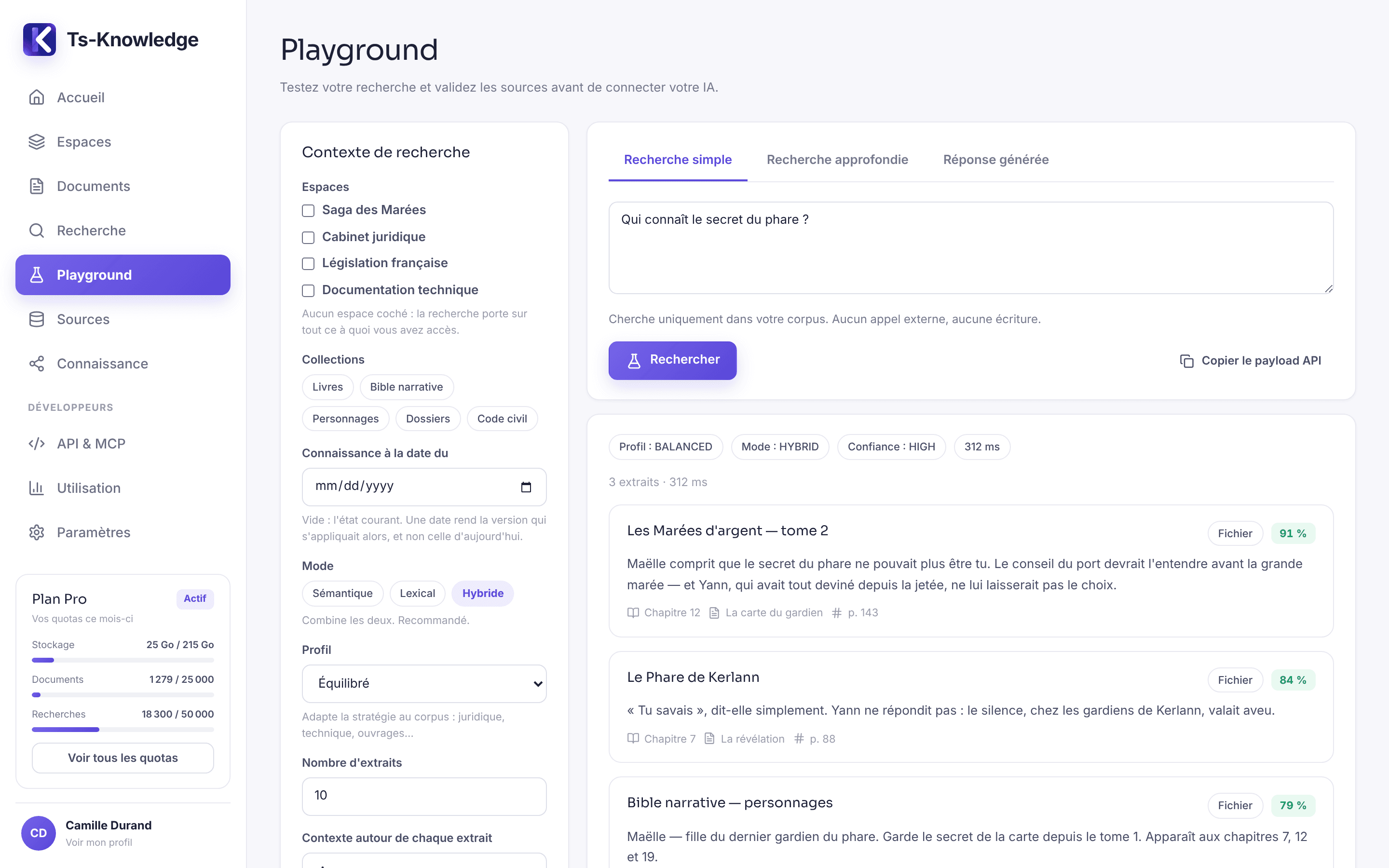
Ask the question the way it comes to you. Hybrid search combines meaning and exact wording: “the keeper's daughter” and “Ouessane” both find their passage. And when your texts don't contain the answer, Ts-Knowledge says so instead of inventing one.
2 · Understand
Turn on extraction for your universe: every book you import is read, and Ts-Knowledge draws out what it asserts — characters, places, groups, secrets, events — keeping, for every value, the sentence that proves it.
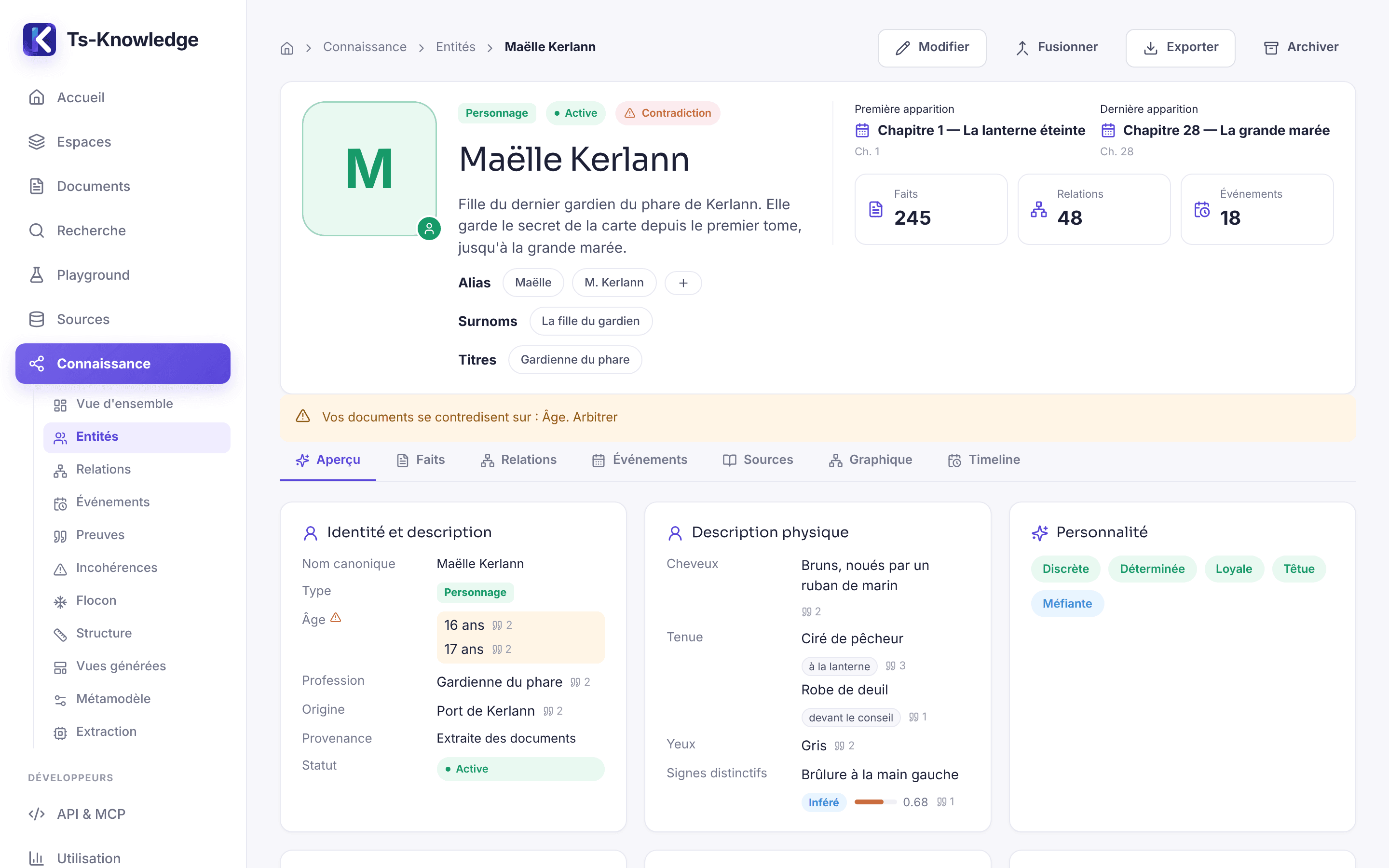
The lighthouse secret, and the characters who know it: a facet of its own, because what a character knows isn't what the reader has read.
Friend, mentor, rival, member of the Confrérie: the graph of links, a solid line if it's written, a dotted one if it's inferred.
“The law of the great tides”, “the fire never goes out”: what your world allows, and on what conditions, tied to what it governs.
Different isn't contradictory: a form taken in another scene doesn't trigger an alert. Two incompatible values do — ranked by severity.
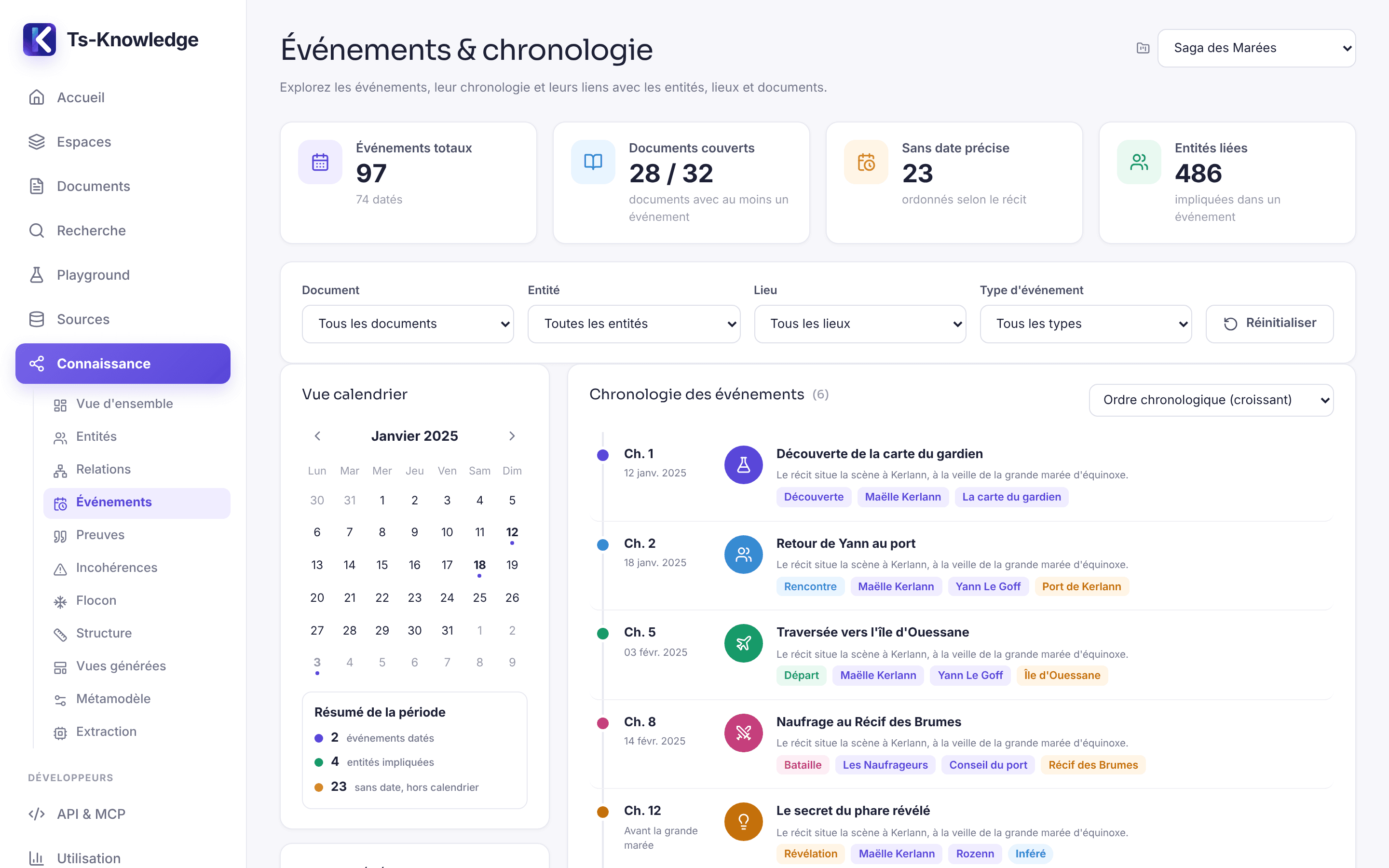
The discovery of the keeper's map, Yann's return to the harbor, the crossing to Ouessane, the shipwreck on the Récif des Brumes: every event with its participants and the chapter where it happens. Dated when the text allows it, ordered by book otherwise.
For a cover or character sheets: a detailed visual description, ready for an image-generation AI, written from sourced facts alone — one per form. Gwenola in her human form, and in her seal form. Whatever the book leaves unsaid is flagged as a gap, never filled in.
Extraction and illustration prompts are written with the model key you connect — or by your own agent, via MCP. Same instructions, same verification: nothing is written without evidence.
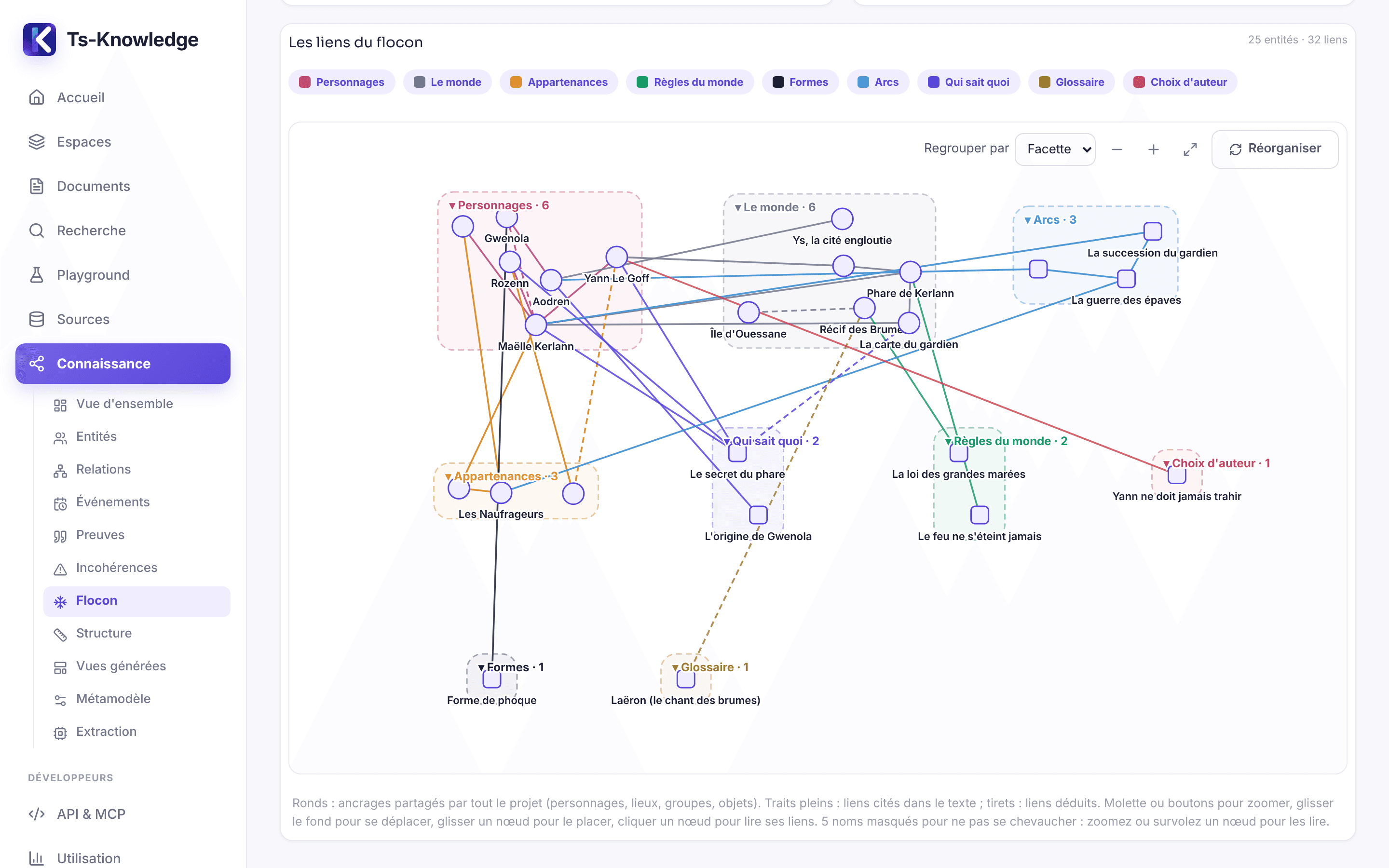
The Knowledge Snowflake
Ten facets — characters, the world, affiliations, world rules, forms, arcs, who knows what, timeline, glossary, author's choices — each with its own arm, and one ring per book: that's the Snowflake (the “Flocon” screen in the app). The bigger the dot, the more that book has to say. An empty facet stays empty: you see what's missing before your readers do.
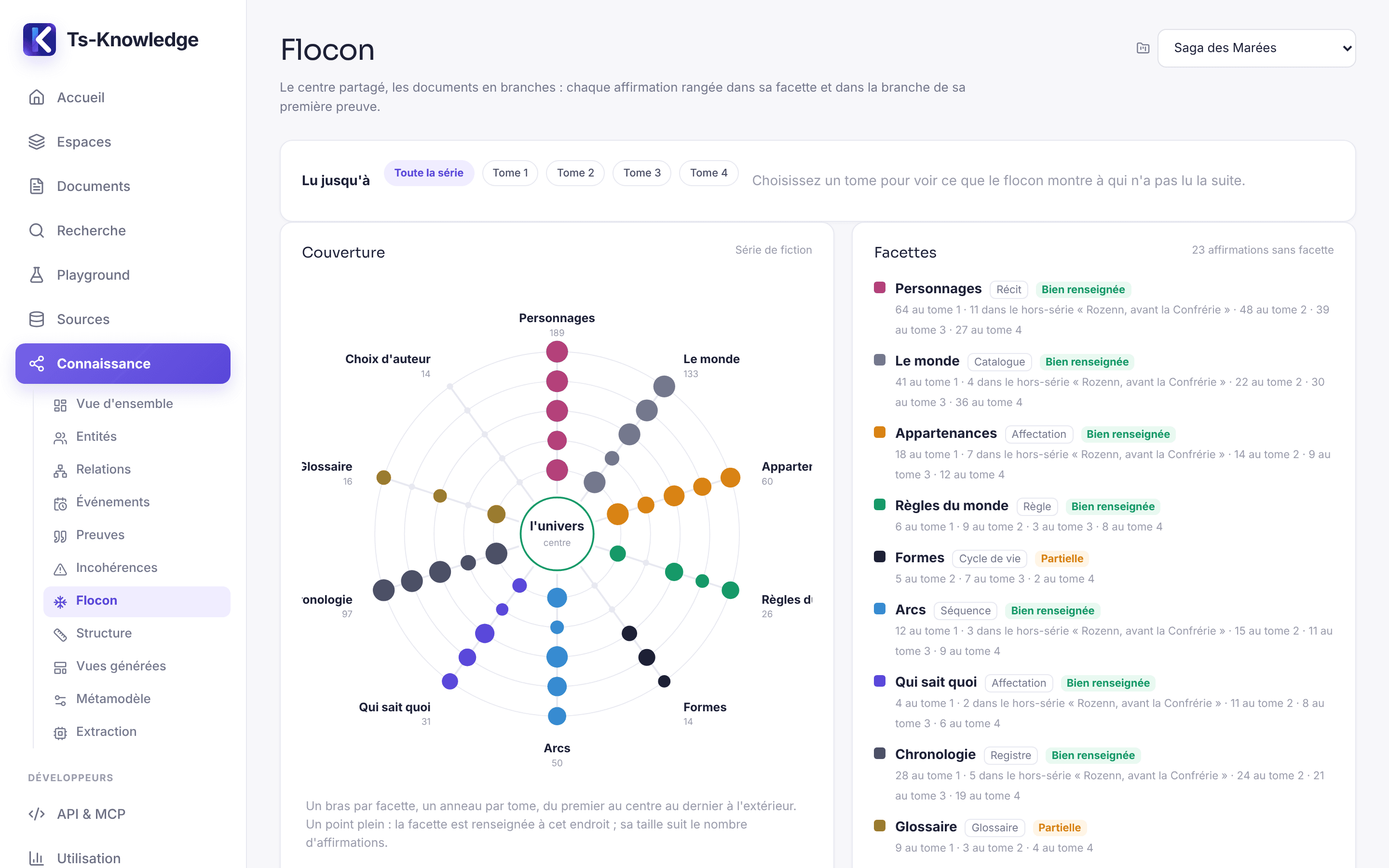
Set the limit, and everything is bounded by what a reader who stopped there can know: excerpts, profiles, facts, links, names. Gwenola, who only appears in Book 3, comes back “not found” — as if she didn't exist.
For the writing itself
Three acts, Save the Cat, or the structure you've built for yourself — “even-numbered book: the crisis between 65 and 82%”. Ts-Knowledge places each chapter between 0 and 100% of the book, and your agent reviews it: which chapter carries each key beat, and does it really deliver?
Entered on screen, or converted by your agent from your notes. One variant per family of books: odd-numbered, even-numbered, or positions you pick.
Beats, chapters, gaps measured in points: no score. Whatever the grid doesn't define stays empty, and the review never invents a purpose for it.
Chapter positions are measured by the server, never by the model. The agent's review is re-checked, quotes included.
3 · Connect
Claude, ChatGPT, Gemini or Mistral connect to Ts-Knowledge over MCP. Your agent checks the map, searches, verifies the profile — then writes, citing its sources.
I'm rewriting chapter 7 of Book 3. At that point, does Yann already know what the lighthouse is hiding?
get_knowledge_flakeSaga des Marées · read up to Book 2“Who knows what”: 2 secrets · “Author's choices”: your notesget_entity_relationsYann Le Goffknows: The lighthouse secret · since Book 2search_knowledge“Yann lighthouse secret jetty”Book 2, ch. 12, p. 143 · author's notesYes: he guessed it from the jetty Book 2, ch. 12, p. 143. He has never told Maëlle. Your notes specify that he must never betray herauthor's notes — your chapter 7 can play on that silence.
report_used_chunks2 excerpts were usedOne key per universe: your agent stays inside the saga you're writing.
One space per branch — Series, Notes, Drafts — grouped under a hub in one click.
EPUB, PDF, DOCX or Markdown, plus the Drive folder with your drafts. Give each book its place in the reading order.
Choose the “Book” template: profiles, links, timeline and Snowflake build up with every import.
A key restricted to your universe, an MCP URL, and your agent writes alongside you.
Extraction is off by default. Once enabled, it uses the model key you connect, on your account — or your own agent, via MCP.
Create your universe, add the first book, and ask it the question your readers are already asking you.